
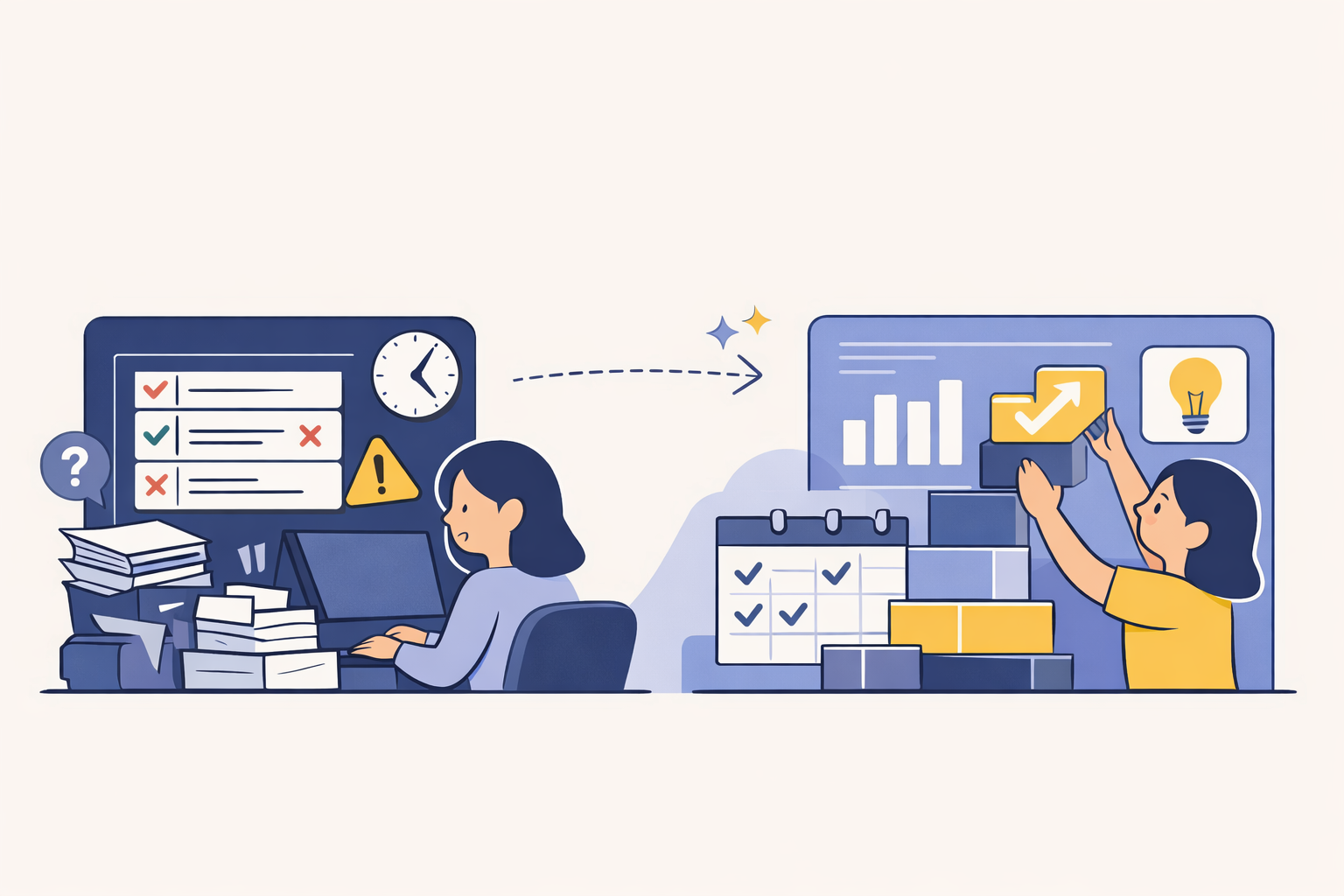
In today’s fast-paced corporate environment, productivity discussions often revolve around software, AI, and flexible policies. Yet, many organizations still struggle with missed deadlines, scattered focus, and employee burnout. The missing piece of the puzzle isn’t usually a lack of talent; it is often a lack of support for executive functioning in workplace training.
Defining executive functioning in adult learners
Executive functioning (EF) is frequently described as the brain’s “command center” or its “air traffic control system”. It is a set of high-level cognitive processes that manage more basic abilities like attention and memory. For an adult learner, executive functioning acts as the mental framework required to plan, organize, strategize, and execute complex tasks.
In the workplace, these skills are generally grouped into three core pillars:
- Working memory: the ability to hold and manipulate information in the mind over short periods.
- Inhibitory control: the capacity to resist distractions, control impulses, and maintain professional composure under stress.
- Cognitive flexibility: the mental agility to pivot between tasks, reframe priorities, and adapt to changing environments.
How executive functioning impacts performance and decision-making
Executive functioning is not just a “soft skill”- it is a critical driver of business outcomes. Research indicates that leaders with superior executive functions significantly outperform their peers, resulting in higher profitability and better business performance.
When executive functioning is robust, learners can:
- Make better decisions: ef allows individuals to analyze situations, identify core challenges, and develop strategic responses rather than reacting impulsively.
- Maintain persistence: strong ef helps learners “wrestle” with difficult content and manage the frustration of long-term projects. By anticipating obstacles, they can devote more cognitive energy to problem-solving rather than becoming dysregulated by setbacks.
- Optimize productivity: employees with strong ef skills are better at time management, discerning what is crucial from what is merely urgent.
Conversely, when these cognitive processes are overwhelmed-a state often called a “low brain battery”– performance glitches appear. This can look like missed micro-signals, such as requests for repeated information or resistance to last-minute pivots, which are often misinterpreted as character flaws rather than cognitive roadblocks.
Why interactive simulations strengthen executive functioning
To effectively support executive functioning in workplace training, organizations must move beyond passive lectures. Interactive simulations are a powerful tool because they align with the way the brain naturally learns and constructs knowledge.
1. Fostering generative processing according to cognitive load theory, effective instruction should foster “generative processing,” where learners actively organize and integrate new information. Simulations require learners to engage in active problem-solving, which helps build and automate new “schemas” in long-term memory, eventually making complex tasks feel easier.
2. Providing real-world context adult learners, particularly those with adhd or ef challenges, are more engaged by real-world problems that require lateral thinking. Interactive simulations allow employees to practice “outside-the-box” solutions in a safe environment, mirroring the “high-stakes” crisis situations where they often excel.
3. Strengthening inhibitory control and flexibility by forcing learners to make decisions under simulated pressure, training can help strengthen inhibitory control. Simulations can incorporate “break reminders” or “reflective pauses” to teach learners how to re-engage their frontal lobe during tense moments, preventing emotional dysregulation from compromising their performance.
The business case for training aligned with executive functioning
Investing in executive function support is a strategic imperative. Organizations that prioritize these cognitive mechanics see measurable business benefits, including:
- Reduced managerial overhead: when employees can self-manage effectively, managers spend less time chasing updates and more time on strategy.
- Higher retention: addressing EF deficits reduces the “cognitive stress” that leads to burnout and voluntary turnover.
- Increased corporate productivity: organizations that incorporate coaching focused on these cognitive skills have seen corporate productivity increases of up to 19%.
By modernizing workplace training that respects the limitations of working memory and leverages the power of interactive simulation, companies can transform potential performance issues into significant growth opportunities.
Want to assess whether your training supports executive functioning?
We offer structured EF-aligned learning audits for organizations modernizing workforce capability.
Astrocyte Media designs learning-science-informed interactive experiences that strengthen executive functioning, resilience, and sustained engagement in adult learners.
We partner with organizations to build structured learning systems (not just content) that translate cognitive science into measurable performance outcomes.
If your organization is modernizing training, leadership development, or workforce capability, we’d love to help you design environments that support real growth.
References
Brock, R. (2025, February 24). Understanding executive functioning matters more than ever. Belt.ai. https://belt.ai/stories/understanding-executive-functioning-matters-more-than-ever
Gillan-Bronze, A. (2021, May 12). 7 tips for ADHD-friendly eLearning…from an instructional designer with ADHD. eLearning Industry. https://elearningindustry.com/7-tips-for-adhd-friendly-elearning-from-instructional-designer-with-adhd
Harper, J. (2025, July 24). Training managers to recognize executive dysfunction in the workplace for proactive performance management and a neuro-inclusive culture. Coaching Executive Function. https://www.coachingexecutivefunction.com/post/training-managers-to-recognize-executive-dysfunction-in-the-workplace
Job Accommodation Network. (2018, May 31). Employees with executive functioning deficits effective accommodation practices (EAP) series. https://askjan.org/publications/effective-accommodation-practices-eap-series-employees-with-executive-functioning-deficits.cfm
Monn, D. (2023, August 30). How executive function coaching can empower your leadership skills. MentorCruise. https://mentorcruise.com/blog/how-executive-function-coaching-can-empower-your-leadership-skills/
Nappa, A. (2016, September 6). Emotional regulation and executive function skills: A powerful link. Beyond BookSmart. https://www.beyondbooksmart.com/executive-function-blog/emotional-regulation-and-executive-function-skills-a-powerful-link
Sahakian, B. J., & Christopoulos, G. (2023, April 17). Cognitive flexibility: The science of how to be successful in business and at work. SHRM. https://www.shrm.org/topics-tools/news/coaching/cognitive-flexibility-science-how-to-be-successful-in-business-at-work
Waxman, J. B., & Goldie, S. J. (n.d.). Cognitive load theory: Learning & instructional design. Center for Health Decision Science, Harvard T.H. Chan School of Public Health. https://chds.hsph.harvard.edu/resource-pack/cognitive-load-theory-learning-instructional-design/
Weinberger, E. (n.d.). Demystifying soft skills. Staying Ahead of the Game. https://saotg.com/demystifying-soft-skills/