
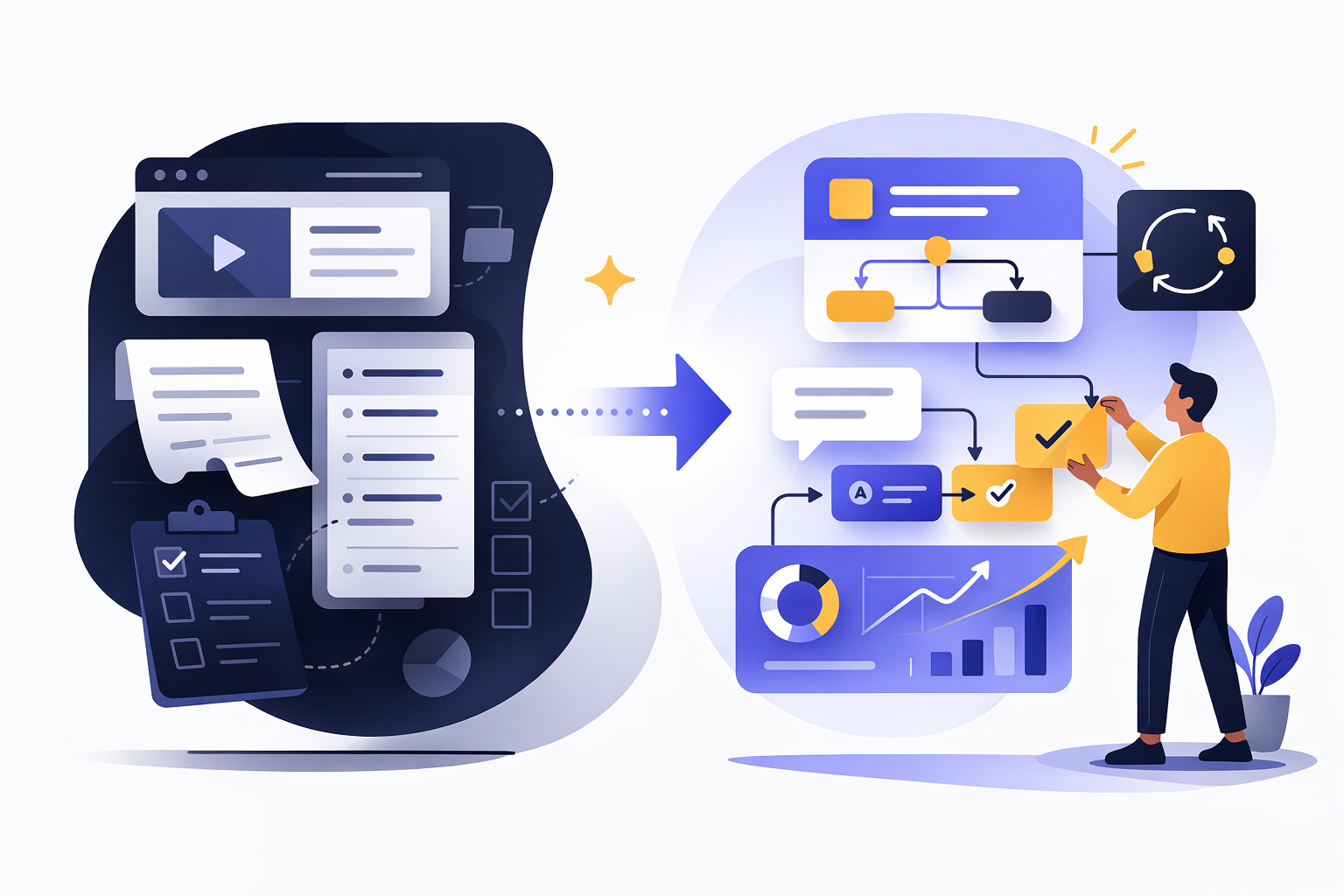
The days of sitting through hours of static presentations and dense manuals are fading, as traditional instructional ways often fail to bridge the massive gap between theoretical knowledge and real-world execution.
Today’s learners require a shift toward modernization and competency-based mastery, and simulation-based training (SBT) has emerged as the unlikely hero. By creating immersive environments that replicate real-world challenges without real-world consequences, simulation allows adult learners to develop the “muscle memory” required for critical thinking and technical proficiency.
The science of why adult learners love simulation
To understand why simulation works, we have to look at andragogy: the study of how adults learn differently than children. Unlike kids, adult learners are self-directed, bring a wealth of prior experience to the table, and are primarily motivated by the immediate utility of information.
- Learning by doing: Research shows we remember only 10% of what we read but roughly 90% of what we do.
- The experiential cycle: David Kolb’s experiential learning theory (ELT) states that knowledge is created through the transformation of experience. Simulation is uniquely capable of facilitating Kolb’s entire four-stage cycle in a single session: concrete experience, reflective observation, abstract conceptualization, and active experimentation.
- Safe-to-fail zones: One of the greatest psychological benefits is the “safe-to-fail” environment, where learners can experiment and make mistakes without risking revenue, reputations, or lives.
Proof from the front lines
Simulation isn’t just a theory, it’s a proven success in high-stakes industries:
- Aviation: This industry pioneered crew resource management (CRM), a team-based training that moved aviation from a “risky” safety rating to one of the safest modes of travel in the world.
- Healthcare: Meta-analyses confirm that simulation-based medical education is superior to traditional instruction, leading to better clinical performance and increased patient safety. For example, simulation has been shown to reduce medical errors in anesthesia by 43%.
- Corporate leadership: Business simulations allow managers to practice emotional intelligence and crisis response by leading virtual teams through restructuring or high-pressure negotiations.
The tech revolution: AI, VR, and AR
We are entering a new era where artificial intelligence (AI) and extended reality (XR) are making simulations more accessible and effective than ever before.
- VR/AR efficacy: Learners trained with immersive VR are 4 times faster to train and 275% more confident to apply their skills compared to classroom learners.
- AI-driven scenarios: Platforms like AIMS (AI-enhanced immersive multidisciplinary simulations) use generative AI to support realistic, unscripted conversations with virtual patients or clients.
- Augmented reality (AR): In industrial settings, AR overlays digital data onto real-world equipment, which can result in a 90% reduction in errors.
The bottom line: ROI and retention
While simulation technology requires an initial investment, the return on investment (ROI) is undeniable.
- Time efficiency: The transfer effectiveness ratio (TER) for simulation is often around 0.66, meaning every hour of simulation saves 0.66 hours of training on a real task.
- Talent retention: Professionals value growth; simulation-based development can increase employee retention by 30% to 50% because it builds self-efficacy and reduces the burnout associated with high-stress roles.
The secret sauce: the debrief
The simulation itself is only half the battle; the real magic happens during the debriefing. Facilitated reflection allows learners to close knowledge gaps and analyze the “why” behind their decisions. The PEARLS framework – which moves from emotional reactions to deep analysis and finally to workplace application – is the industry gold standard for turning a virtual experience into enduring professional wisdom.
Conclusion
Simulation-based learning is no longer a luxury; it is a strategic necessity for any organization looking to survive in an unpredictable world. By respecting the adult learner’s need for autonomy and relevance, simulation creates a workforce that is not just knowledgeable, but truly ready to perform.
References
Andreatta, P., Saxton, E., Thompson, M., & Annich, G. (2011). Simulation-based mock codes significantly correlate with improved pediatric patient cardiopulmonary arrest survival rates. Pediatric Critical Care Medicine, 12(1), 33-38. https://doi.org/10.1097/PCC.0b013e3181e89270
Baashar, Y., Alkawsi, G., Wan Ahmad, W. N., Alhussian, H., Alwadain, A., Capretz, L. F., Babiker, A., & Alghail, A. (2022). Effectiveness of using augmented reality for training in the medical professions: Meta-analysis. JMIR Serious Games, 10(3), e32715. https://doi.org/10.2196/32715
Bouchrika, I. (2026). The andragogy approach: Knowles’ adult learning theory principles for 2026. Research.com. https://research.com/education/the-andragogy-approach
Bukhari, H., Andreatta, P., Goldiez, B., & Rabelo, L. (2017). A framework for determining the return on investment of simulation-based training in health care. Inquiry: A Journal of Medical Care Organization, Provision and Financing, 54. https://doi.org/10.1177/0046958016687176
Eppich, W., & Cheng, A. (2015). Promoting Excellence and Reflective Learning in Simulation (PEARLS): Development and rationale for a blended approach to health care simulation debriefing. Simulation in Healthcare, 10(2), 106-115. https://doi.org/10.1097/SIH.0000000000000072
Jiang, Z., Hang, H., Wu, X., Xiang, S., & Pan, S. (2025). Methodological innovation in evaluating the cost-effectiveness of simulation training combining transfer effectiveness and change-point analysis. Journal of Medical Education and Curricular Development, 12. https://doi.org/10.1177/23821205251368247
Knapke, J. M., Hildreth, L., Molano, J. R., Schuckman, S. M., Blackard, J. T., Johnstone, M., Kopras, E. J., Lamkin, M. K., Lee, R. C., Kues, J. R., & Mendell, A. (2024). Andragogy in practice: Applying a theoretical framework to team science training in biomedical research. British Journal of Biomedical Science, 81, 12651. https://doi.org/10.3389/bjbs.2024.12651
Kolb, D. A. (1984). Experiential learning: Experience as the source of learning and development. Prentice-Hall.
Lateef, F. (2010). Simulation-based learning: Just like the real thing. Journal of Emergencies, Trauma, and Shock, 3(4), 348-352. https://doi.org/10.4103/0974-2700.70743
McLeod, S. (2025). Kolb’s learning styles and experiential learning cycle. Simply Psychology. https://www.simplypsychology.org/learning-kolb.html
McQuillen, B. (2026). Augmented reality for employee training and skill development: The future of learning at work is already here. Ignite HCM. https://www.ignitehcm.com/blog/augmented-reality-for-employee-training-and-skill-development-the-future-of-learning-at-work-is-already-here
Meguerdichian, M., Bajaj, K., Ivanhoe, R., Lin, Y., Sloma, A., de Roche, A., Altonen, B., Bentley, S., Cheng, A., & Walker, K. (2022). Impact of the PEARLS Healthcare Debriefing cognitive aid on facilitator cognitive load, workload, and debriefing quality: A pilot study. Advances in Simulation, 7, 40. https://doi.org/10.1186/s41077-022-00236-x
O’Dea, A., O’Connor, P., & Keogh, I. (2014). A meta-analysis of the effectiveness of crew resource management training in acute care domains. Postgraduate Medical Journal, 90(1070), 699-708. https://doi.org/10.1136/postgradmedj-2014-132800
Wang, R., Lu, J., Pei, B., Jones, E., Brinson, J., & Brown, T. (2025). Designing and evaluating an AI-driven Immersive Multidisciplinary Simulation (AIMS) for interprofessional education. arXiv preprint arXiv:2510.08891. https://arxiv.org/html/2510.08891v1
Zendejas, B., Brydges, R., Wang, A. T., & Cook, D. A. (2013). Patient outcomes in simulation-based medical education: A systematic review. Journal of General Internal Medicine, 28(8), 1078-1089. https://doi.org/10.1007/s11606-012-2264-5